


TNREGINET - Tamil Nadu Guideline Value 2026
TNREGINET is the online portal of the Tamil Nadu Registration Department. It provides various services related to property registration, including Issuance of Encumbrance Certificate (EC), Property Registration, Finding Land Guideline Values, and online viewing of Encumbrance Certificates.
Encumbrance certificate is a vital legal document that proves whether the property owner is original or not. The document also proves that the property is encumbered to a bank, if it is mortgaged to the bank.
Encumbrance certificate can be applied through Inspector General of Registration (IGRS) Tamil Nadu or TNREGINET is an online portal developed by the Government of Tamil Nadu to simplify the registration process (marriage, birth, death, firm, chit fund, etc.). You can also check or search for an encumbrance certificate through this portal.
The portal also has detailed information on stamp and registration fees pertaining to various categories. Other than these, you can also check for property valuation through TNREGINET Government Portal.
The Tamil Nadu government has recently revised the guideline values for properties, impacting registration fees and transaction volumes.
The registration department reported a significant revenue increase in the 2025-2026 financial year compared to the previous year, attributed to the guideline value revisions.
Important Details to Know About Encumbrance Certificate
Here are the following details that you must know about Encumbrance Certificate:
- A legal document issued sub-registrar under whose jurisdiction the property is located
- The documents consist of vital details, such as property details, transactions, and others
- This is a valid proof that confirms that the property owner is original and prevents disputes
- EC is required during either sale or purchase of property, applying for home loan, or loan against property
- Types of EC forms are Form 15 and 16
- The validity of EC is up to 30 days
When Do You Need an Encumbrance Certificate in Tamil Nadu?
Here are the circumstances when you need to have an EC in Tamil Nadu apart from seeking an independent house for sale in Tamil Nadu:
- Applying for home loan
- Purchasing house
- Seeling house
- Change property value
- Withdraw fund out of your Provident Fund to purchase a house
Importance of Encumbrance Certificate
If you want to buy or sell a property, or if you want to apply for a home loan against it, you must obtain an encumbrance certificate. The certificate helps in proving the owner's legitimate ownership of the property.
Additionally, a person who possesses the certificate is qualified to receive advances or loans against property from banks and other financial institutions. It proves that there are no financial or legal obligations associated with the designated property.
Process to Apply for Encumbrance Certificate Online in Tamil Nadu
The process to apply for an encumbrance certificate in Tamil Nadu is as follows:
- If this is your first time using the website, you will have to register and fill out a form with your name, address, phone number, identification number, and other information.
- To receive an OTP, fill out the sign-up form. Look for a verification link from the authority in your email address.
- Log in to the TNREGINET portal after your information has been validated.
- On the main page, navigate to the ‘E-services’ tab and select the ‘Encumbrance Certificate’ option.
- Click on ‘Search and Apply EC’ and enter the requested information.
- Enter the captcha displayed on the screen.
- Click on the ‘Search’ option.
- Select the ‘Apply Online’ option.
- Enter your name and contact information and save it.
- To access the e-payment screen, choose the pay option after viewing the payment details.
- Fill in the e-payment section with your information, including your name, address, and sub-registrar office.
- Pay the amount from a bank account of your choice.
You will receive a bank reference number, CIN number, and transaction ID as soon as your payment is approved.
Process to Apply for Encumbrance Certificate Offline in Tamil Nadu
To apply for an EC in Tamil Nadu offline, the following documents are required:
- Attested copy of address proof
- Title details
- Property details
You will also have to pay the appropriate fee.
- Visit the sub-registrar’s office with the documents mentioned above.
- Submit an application with the aforementioned documents.
- The relevant authority will review all the documents to determine their legality.
- Either a Nil Encumbrance Certificate or an EC with all transaction details will be issued. It might take between 15 and 30 days from the application date.
Documents Required Obtain Encumbrance Certificate
The following is the list of documents required to obtain encumbrance certificate for offline and online application mode:
Offline:
- Property details
- Address proof of the applicant
- Property’s registration copy
- Title deed
- Registration copy of property
- Deed number of property registration that consist of book number, date, and applicant’s signature
Online:
- Applicant’s Aadhar card copy
- Signature
- Application status
- Purpose of applying for EC
- Attested copy of the applicant’s address proof
- Copy of Power of Attorney
- Copy of partition, sale, gift or release deed (if any)
- Property address documents, including survey number or patta number
- Property registration documents that consist of deed and book numbers date, and applicant’s signature
Encumbrance Certificate Validity in Tamilnadu
Encumbrance certificate is a legal document that consists of all the details of the property transaction that took place within a specified duration and has a validity of up to 30 years.
How to Track Status of Encumbrance Certificate in Tamil Nadu
Based on the state website, there are different steps involved in checking the status of the EC application. Here is how you can check the application status of an EC in Tamil Nadu:
Step 1: Visit the TNREGINET portal.
Step 2: Under ‘E-services,’ select the ‘E-Payment’ option.
Step 3: Select ‘Payment’ and click on the ‘Payment Status’ option.
How to Check Encumbrance Certificate Online in Tamil Nadu?
The following are the steps to check the Encumbrance certificate online in Tamil Nadu:
- Visit tnreginet.gov.in to navigate to the Tamiladu Registration Department’s home page
- Select English language, if necessary
- Click on ‘E-Services’ option
- Click on ‘View EC’ under Encumbrance certificate, to view your EC
- Select your EC, you can also download it on your device
- Then, click on ‘Sub-Registrar Office’ under ‘District’ that comes under ‘Zone’
- Provide the start and end date for EC
- Select the village
- Enter the ‘Enter Survey Number’ under the ‘Subdivision Number’
- Select ‘Add’, under the security code displayed
- Press the search button, to check the result
- Encumbrance Certificate will be displayed, and you can save it for future use
How to Get a Digitally Signed Copy of The EC Online in Tamil Nadu?
Here are the steps to get a digitally signed copy of EC online in Tamil Nadu:
- Visit the official website of www.tnreginet.com
- Select ‘E-services’
- Select ‘Encumbrance Certificate’
- Click on ‘Search and Apply EC’
- Create a new ID using the above steps and log in again
- Make EC payment
- The digitally signed copy of EC will be available via ‘Request List’ option
Tamil Nadu Encumbrance Certificate Charges
Here are the details regarding Tamil Nadu encumbrance certificate charges:
- Application fee: Re.1
- Search fee for first year: Rs.15
- Search fee for the following years: Rs.5
- Additional fee: Rs.100 (after computerised period from 1987 onwards)
- Issue and search (copy per certificate) EC: Rs.200
- Issue EC copy for a period of up to 30 years: Rs.200 per certificate
- Issue of EC that has been in existence for more than 30 years: Rs.500 per certificate
What is the online payment method?
The following is the process to make online payment:
- Log into the official website of TNREGINET (https://tnreginet.gov.in)
- Under the e-payment option, generate NEFT or RTGS challan available
- Make payment as mentioned
- opt for NEFT or RTGS option, after selecting the SBI payment gateway
- Take a print of the NEFT or RTGS payment challan
- Using the challan, make the payment except in SBI
- Log into the portal and print the acknowledgement
What is the offline payment method?
Here are the details of offline payment method:
- Paying the fees in the branch by visiting physically is the offline payment method
- Log into the portal and go to e-payment option
- Fill in the required details
- Select offline payment mode
- Generate offline payment challan
- Make the payment using the challan
Note: Users must avoid paying challan using common slips in the following bank branches:
How Long Does It Take to Receive an Encumbrance Certificate After Applying?
The time taken to receive an Encumbrance Certificate after applying depends on whether it applied through online or offline mode. Here is time period for receiving EC for both the application mode:
- Online: Five to seven days
- Offline: 15 to 30 days
How to Correct an Encumbrance Certificate in Tamil Nadu?
Here are the following details that one must understand about correction of EC in Tamil Nadu:
- Apply for a rectification deed
- Provide documentation that the previous encumbrance certificate contained errors
- No substantive alterations can be made as the only adjustment that can be made are clerical
- Documents that have been filed to the sub-office registrars are irreversible
- Therefore, rectification deed does not contain any errors in the original documents
How to download Encumbrance Certificate in Tamil Nadu?
The following are the steps to download the Encumbrance Certificate in Tamil Nadu:
- Visit the official website of the Tamil Nadu registration department
- Through the TNREGINET portal, follow the process of online EC view
- Click on the encumbrance certificate option
- choose the view or download the encumbrance certificate
- You can download the Villangam certificate, which is also accessible through the QR code provided on your registered contact number or email after the certificate is ready
How to update an encumbrance certificate (EC)?
Here is the detail procedure to update an encumbrance certificate:
- Update the property ownership for which property deed and NOC (No Objection Certificate) is required
- Check for all the liabilities and property tax receipt and other proofs are required
- Check for legal liabilities and details of ongoing legal disputes
- Get the latest EC by submitting the duly filed EC application form
- Update the latest EC transaction history
- to ensure all taxes and liabilities have been settled, verify the ownership of the property
- To get the latest EC copy with the update details, visit relevant authority the sub-registrar’s office
How to Register on Official TNREGINET Website?
The following are the steps to register on official TNREGINET website:
- Visit the website https://tnreginet.gov.in/portal/
- Under the ‘Registration’ tab, click on User Registration option
- By providing relevant details, complete the registration form
Within seven days of the user profile’s creation, the new users will be able to use registered user’s services on TNREGINET. After deactivation of their User ID, avail the services every three months from the date of the last activity on TNREGINET.
Limitations of Encumbrance Certificate in Tamil Nadu
The following are the limitations of Encumbrance Certificate in Tamil Nadu:
- Details of only the period requested for is present in EC
- Details prior to this period are not present in EC
- Oral agreement or unregistered documents also not present in EC
How to search Tamil Nadu encumbrance certificate online on TNREGINET
The following are the steps to search for the online encumbrance certificate of Tamil Nadu on TNREGINET:
- Visit the official website of Inspector General of Registration (IGRS) Tamil Nadu or TNREGINET
- Select ‘ENCUMBRANCE CERTIFICATE’ at the bottom of the page
- For online EC, click on it
- Click on e-Services to open a new tab to select online EC
- on the page redirected to enter the required details, such as:
- Zone
- District
- Sub-registrar office
- EC start and end date
- Survey details such as village, survey number and subdivision number
- To search for your EC/ Villangam certificate, enter the captcha code to confirm
- opt for the ‘document-wise’ option
- Enter the required details, such as:
- Sub-registrar office
- Document number
- Year
- Document type
- Enter the captcha, to search for the online EC
States that issue encumbrance certificate
The following are the states that issue online EC are:
- Andhra Pradesh
- Kerala
- Odisha
- Puducherry
- Tamil Nadu
- Telangana
Difference between encumbrance certificate vs non-encumbrance certificate
The following are the differences between encumbrance certificate and non-encumbrance certificate:
Encumbrance certificate | Non-encumbrance certificate |
The Encumbrance Certificate (EC), issued on Form 15, provides information about the land's inheritance pattern, sale and purchase transactions, leases, and mortgage-related details, among other things. | The Non-Encumbrance Certificate, issued on Form 16, certifies that there are no mortgages on the property, indicating that no one else can claim ownership. |
Certificate is received within 15 to 30 days | Certificate is received within 20 to 30 days |
How can I check my land guideline value in Tamil Nadu?
Here are the details of how you can check your land guideline value in Tamil Nadu:
- Visit the TNREGINET’s official portal
- Click on Guideline Value
- Under Guideline Search, click on the relevant link
- Guideline value for Street or Survey number can be viewed on the new page
- Choose the relevant option
- choose to search Village wise or Category wise
- Select Zone, Sub registrar office, registration village, and land category
- Click on Search
Contact information of EC Online Tamil Nadu
Here is the contact information of online EC Tamil Nadu:
- Email address: helpdesk@tnreginet.net
- Telephone number: 044-24640160
- Address: No.100, Santhome High Road, Chennai-600028, Tamil Nadu, India
Tamil Nadu EC Search
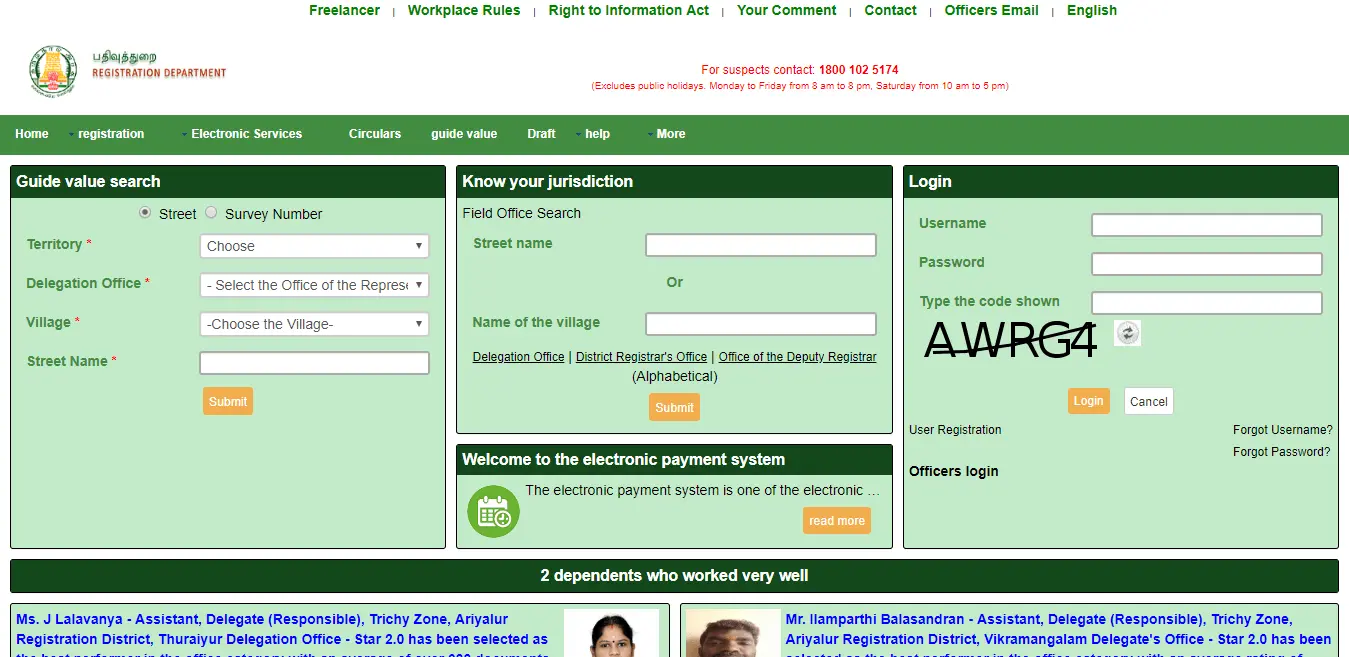
You can look for Tamil Nadu encumbrance certificate through this portal. Here's a step-by-step process to show you how you can search for Tamil Nadu encumbrance certificate.
- Log in to Inspector General of Registration (IGRS) Tamil Nadu official website at TNREGINET Portal.
- On the left-hand side of the page, you will find "E-Services" tab on the menu bar.
- Put your cursor on it; it will show "Encumbrance Certificate".
- Move your cursor to "View EC" and click on it.
- You will be redirected to another page where you have to select from two options— "EC" or "Document-wise".
- If you select "EC", you have to fill in the required fields, including zone, district, Sub-Registrar Office, EC start date, EC end date, and village, among others.
- Enter the captcha and click on the "search" button to check the concerned EC certificate.
- Alternatively, you can view a certificate by selecting the "Document-wise" option.
- Upon selection, fill in the required fields, including Sub-Registrar Office, document number, year, and document type.
- Enter the captcha and click on the "search" button to check the concerned EC certificate.



FAQs on TNREGINET
1.Where can I view the transaction status for my e-payment?
Use this path to check your transaction status - E-services-> E-Payment-> Payment-> Payment status.
2.What is EC transfer?
An encumbrance certificate is an important document for verifying ownership when purchasing land or property. It is crucial for confirming that the property is free from tax dues, legal, or financial issues, and it indicates if the government has any claims on the property for statutory dues. Therefore, an EC is also necessary for property transfers.
3.What is a Non-Encumbrance Certificate in Tamil Nadu?
A non-encumbrance certificate is issued in Tamil Nadu if there are no property transactions during the specified period for an Encumbrance Certificate and is also known as Nil Encumbrance Certificate.
4.What to do if EC application has been rejected?
Applicants must inquire at the sub-registrar office to understand why the EC application was rejected. They need to reapply online or offline with complete documentation.
5.Why is EC taken for 30 years?
An Encumbrance Certificate, obtainable for up to 30 years, that consists of details property records and aids in home loan applications.
6.How to add more properties in a single document?
Users can add multiple properties in a single document by visiting the official portal at https://tnreginet.gov.in/portal/. Select the 'Add' option to include any number of properties and continue with the process.
7.How much does an encumbrance certificate cost?
In Tamil Nadu, an encumbrance certificate charges Re.1 for the first year and Rs.15 for additional information. It costs Rs.100 for computerised encumbrance certificates.
8.What is the validity of an encumbrance certificate?
The validity of an encumbrance certificate is up to 30 years. It should be noted that an EC requested for a specific time frame will only contain information for that duration.
9.What is a nil encumbrance certificate?
In case there aren’t any transactions involving the aforementioned property during the time period for which an encumbrance certificate is requested, a nil encumbrance certificate shall be granted.
10.What is the difference between EC and CC?
When a building is finished following the plans and building rules, the local authority issues a completion certificate (CC), to the developer or builder. If any property has ownership or financial responsibility associated with it, it is defined by an EC.
11.I want to edit the Abstract for Draft Creation document. Is there any particular deadline before which I have to complete the task?
You can edit the document until it's processed in the back office.
12.Can I get registration details from the Sub-Registrar's Office directly?
Yes, you can get registration details from the concerned Sub-Registrar.
13.Who all are considered as "family" while availing stamp duty concession?
According to Stamp Act, "family" comprises of father, mother, husband, wife, son, daughter, brothers, sisters, and grandchild. Also, note that the stamp duty fee for Settlement, Release, Partition, and other such instruments, for family members is 1% (maximum of Rs.25,000). Similarly, the registration fee is also 1% subject (maximum of Rs.4000).
14.Is there any particular timeline to get the encumbrance certificate?
As per the Standing Order 979(ii), with respect to the offices and period, which is not computerised, the encumbrance certificate shall be completed and issued within 4 days from the date of application submission. For computerised period, the encumbrance certificate will be issued right away.
15.Why is it important to have encumbrance certificate?
With encumbrance certificate, you can get detailed information on previous transactions, which will help you achieve proper entitlement of the concerned property. Hence, it's always recommended to get encumbrance certificate.

Kankana Mukherjee is an engineer and has over 4.5 of experience in content writing. Combining the expertise in financial content writing achieved in her 2 years association with BankBazaar, and a knack for clear and engaging content, Kankana simplifies complex financial concepts and offers practical insights to help readers make informed decisions and achieve financial success.

Disclaimer
Credit Card:
Credit Score:
Personal Loan:
Home Loan:
Fixed Deposit:


Copyright © 2026 BankBazaar.com.