


NABARD - National Bank for Agriculture and Rural Development Overview
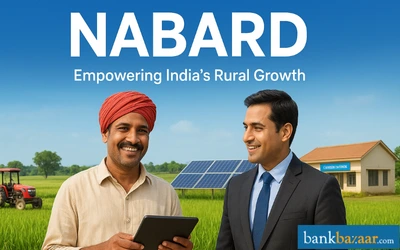
The National Bank for Agriculture and Rural Development (NABARD) was established in 1982 through the NABARD Act. It fosters sustainable and equitable agriculture and rural prosperity. This organisation operates as a central agency for policy planning, credit disbursement, and monitoring of the rural economy. It primarily functions as a refinancing agency for Cooperative Banks and Regional Rural Banks (RRBs). They offer short- and long-term refinancing along with direct lending for variable tenures. By integrating financial assistance with developmental initiatives, the institution aims to enhance long-term viability of India’s primary sector. Read on to learn more about this organisation.

What is NABARD?
NABARD stands for National Bank for Agriculture and Rural Development. It is a financial institution that was set up by the Indian government to promote sustainable agriculture and rural development in the country. It provides financial and non-financial solutions, institutional development and also includes propagation of technological innovations. Initiatives under this organisation include the constitution of an empowered rural India. The institution has three goal-oriented departments for achieving its motive:
- Finance department:
- Management of disbursement of refinance to various financial institutions
- Provides direct lending for projects that bolster rural infrastructure and agricultural production.
- Developmental Department:
- Focus on non-financial interventions
- Promotes social innovations
- Support tribal development
- Foster technological advancements
- Supervisory Department:
- Financial health and regulatory compliance of Regional Rural Banks (RRBs) and Cooperative Banks
- Maintain a robust and transparent rural credit system.

Key Achievements of NABARD
- Refinance Assistance: NABARD provides liquidity to Regional Rural Banks and Cooperatives. It ensures they have the capital necessary to fund local agricultural loans.
- District Credit Planning: NABARD prepares annual District Credit Plans to map out potential lending areas. It guides banks toward meeting these development targets.
- Rural Infrastructure Funding: By financing roughly 20% of India's rural infrastructure, NABARD enables the construction of vital assets like irrigation systems, warehouses, and rural roads.
- Watershed and Climate Initiatives: It pioneered watershed development programs to manage natural resources effectively and protect agricultural land from the impacts of climate change.
- SHG Bank Linkage Project: This flagship microfinance initiative connects self-help groups with formal banking, empowering millions of rural women to become financially independent.
- Kisan Credit Card (KCC): Designed by NABARD, this scheme provides crores of farmers with timely and hassle-free access to credit for their cultivation needs.
- Banking Supervision: NABARD monitors and inspects RRBs and Cooperative Banks to ensure they follow financial practices and remain stable for rural depositors.
- Artisan Training and Marketing: The organization provides vocational training to rural artisans and creates marketing platforms to help them sell traditional handicrafts more profitably.
- Financial Inclusion: It actively promotes modern banking habits in economically backward regions to integrate marginalized communities into the formal economy.
Objectives of NABARD
The key objectives of NABARD are listed below:
- Boosts agricultural production and rural development through institutional growth, financial support, and implementation of development schemes.
- Refinances commercial banks, regional rural banks, and other financial institutions to provide credit facility to the agriculture.
- Offers capacity building, training, and technology support for cooperative banks, RRBs, and microfinance entities to strengthen rural financial institutions.
- To improve connectivity and market access, it provides financial assistance for rural infrastructure projects, such as irrigation, roads, markets, and other facilities to improve connectivity and market access.
- Support organic farming, watershed management, renewable energy, and agricultural R&D for productivity and climate resilience to promote sustainable agriculture.
- To diversify the rural economy and generate employment, NABARD encourages rural innovation and entrepreneurship by funding startups, agri-businesses, and artisans.
- Works to enhance financial inclusion by supporting banking, credit, and insurance access for small farmers, rural women, and marginalized communities.
Functions of NABARD
Core Functions of NABARD are mentioned below:
- Credit Regulation and Management: NABARD acts as the central coordinator for rural credit. It ensures that financial resources flow efficiently and reliably to the agricultural sector across India.
- Promotion of Sustainable Development: The institution spearheads various social and environmental initiatives designed to foster long-term, eco-friendly growth and prosperity within rural communities.
- Institutional Support for Rural Banks: NABARD helps Regional Rural Banks and Cooperative Banks develop effective action plans for local development by providing strategic guidance and technical assistance.
- Refinancing and Infrastructure Funding: It provides capital to banks and specialized institutions to finance everything from individual artisans and handicrafts to large-scale food processing units and rural infrastructure projects.
Significance of NABARD
NABARD has played a vital role in boosting funding in rural areas; strengthening rural finance and banking practices. Fosters efficient banking systems among rural communities with its developmental and supervisory efforts.
- Strategic Credit Planning: NABARD encourages rural banks to implement refinance strategies and develops district-level credit programs.
- Innovation in Microfinance: NBARD pioneers SHG linkage initiatives that are recognized globally as successful microfinance projects.
- Agricultural Credit Access: NABARD provides access to the Kisan Credit Card for financial support to farmers across the country.
- Skill Empowerment: NABARD trains local artisans to develop and promote indigenous handicrafts.
- Refinancing Mechanisms: NABARD supports rural sectors by offering short- and long-term refinancing solutions for variable tenures.
- Physical Asset Development: NABARD drives improvements in rural infrastructure at regional levels.
- Regulatory Oversight: NABARD ensures effective operations and compliance by regulating Regional Rural Banks (RRBs) and Cooperative Banks.
Interest Rates Charged by NABARD to Banks for Refinance under Different Schemes
Particulars | Interest Rate |
Short Term Refinance Assistance | |
RRBs for financing crop loans | 4.50% |
Commercial banks/RRBs in respect of their finance to PACs towards crop loans | 4.50% |
State co-operative banks for financing crop loans | 4.50% |
DCCBs directly financing crop loans | 4.50% |
ST-Additional SAO/ST (others)/ST (others)/ST (SAO) - SCARDBs | Rates are dynamic and are based on market conditions determined by ALCO |
StCBs/RRBs - Conversion of Short Term- crop loans into Medium Term loans (3% less than the interest rate charged by banks to ultimate beneficiaries subject to minimum interest rate at 8.10%) | 8.10% |
Long Term Refinance Assistance | |
State government for contribution to share capital of co-operative credit institutions | 8.50% |
RRBs/StCBs/SCARDBs | Rates are dynamic and are based on market conditions determined by ALCO |
Direct Lending | |
Warehouse Infrastructure Fund | |
State governments | Bank Rate - 1.50% |
State government corporation | Bank Rate - 1.50% |
Entities promoted by central/state government owned/assisted | PLR + risk premium |
Other entities | PLR + risk premium |
Current Bank Rate | 6.75% |
Current PLR | 7.75% |
Food Processing Fund | |
State governments | Bank rate - 1.50% |
Entities promoted by state governments (without government guarantee) | PLR + Risk Premium |
Entities promoted by state governments (with government guarantee) | Bank Rate - 1.50% |
Other Entities | PLR + Risk Premium |
Current Bank Rate | 6.10% |
Current PLR | 7.10% |
NABARD Scheme
The following are various loans and funds offered under NABARD scheme:
Direct Finance Schemes under NABARD
- Loans for food parks and processing units in designated zones.
- Storage and cold chain loans for building warehouses, cold storages, and cold chain infrastructure to reduce post-harvest losses.
- Provides financial support to marketing federations to enhance agricultural marketing infrastructure.
- Rural Infrastructure Development Fund (RIDF) that funds projects in rural areas, such as roads, bridges, irrigation, and health centres.
- Refinance to cooperative banks to promote agricultural and rural lending.
- Assistance for Farmer Producer Organisations (FPOs) to strengthen collective farming and rural entrepreneurship.
- Alternative Investment Funds (AIF) to mobilize resources for rural enterprises and agri-tech.
- Long-Term Irrigation Fund (LTIF) provides funds to support large-scale irrigation projects to improve water availability.
- Pradhan Mantri Awas Yojana – Grameen (PMAY-G), offering funding assistance for rural housing under this national housing scheme.
- Swachh Bharat Mission – Gramin (SBM-G) offers financial support for sanitation and hygiene initiatives in rural areas.
- Micro Irrigation Fund promotes water-use efficiency through drip and sprinkler irrigation systems.
Refinance Schemes by NABARD
- Short-Term Refinance: Funding for seasonal agricultural operations and input purchases.
- Long-Term Refinance: Capital investment in agriculture and allied sectors.
- Off-Farm Sector Refinance: Supports financially to the enterprises and industries not directly involved in farming, such as rural artisans and micro-enterprises.
Government-Sponsored Schemes via NABARD
Farm Sector Support
- Producer Organisation Development Fund (PODF) provides funds and building capacity thus strengthening FPOs.
- Various subsidies offered by Capital Investment Subsidy Scheme for production of organic and biological agricultural inputs.
- In red- fed regions, the Watershed Development Programme promotes sustainable water resource management.
- The Tribal Development Programme leads agricultural interventions for upliftment of tribal and rural communities
- The Tribal Development Programme promotes socio-economic upliftment of tribal communities through agricultural interventions.
- Funding is provided via New Agricultural Marketing Infrastructure in order to improve rural market yards, storage facilities, and supply chains.
- New Agricultural Marketing Infrastructure that provides funding to improve rural market yards, storage facilities, and supply chains.
- National Livestock Mission focuses on livestock development and productivity enhancement.
- End-Use Monitoring (GSS) ensures effective and transparent use of government subsidies.
- In order to reduce burden on farmers, Interest Subvention Scheme offers interest subsidies on crop loans.
Off-Farm Sector Support
- Credit Linked Capital Subsidy Scheme (CLCSS) assists MSMEs in upgrading technology for better productivity.
- NRLM or NULM (Deendayal Antyodaya Yojana) promotes self-employment and livelihood creation among rural and urban poor.
- Weavers package provides support for traditional weavers and small textile businesses.
Long-term refinance of NABARD
Under Section 25(i)(a) of the NABARD Act 1981, NABARD provides long-term refinance to approved financial institutions. This initiative aims at strengthening their financial resources to ensure adequate credit flow for investment in agriculture, allied activities, and the rural off-farm sector.
Objectives
- Provides refinance support for government credit-linked capital subsidy schemes routed through NABARD.
- Promotes capital formation in agriculture and allied sectors such as animal husbandry, fisheries, and forestry to drive sectoral growth.
- Ensures credit flow for priority initiatives of the Government of India and NABARD.
- Meets the credit needs of Self-Help Groups (SHGs) and Joint Liability Groups (JLGs).
- Supports non-farm sector activities like MSMEs, rural housing, and commercial vehicles to create alternative employment in rural and semi-urban areas.
- Funds projects focused on climate adaptation and mitigation to promote environmental sustainability.
Eligibility
Co-operative Banks and Institutions:
- District Central Cooperative Banks (DCCBs)
- Scheduled Primary Urban Co-operative Banks (PUCBs)
- State Co-operative Agriculture & Rural Development Banks (SCARDBs)
- State Co-operative Banks (StCBs)
Regional and Specialized Banks:
- Regional Rural Banks (RRBs)
- North-East Development Finance Corporation (NEDFC)
- State Agricultural Development Finance Companies (ADFCs)
Commercial and Small Finance Institutions:
- Commercial Banks (CBs)
- Small Finance Banks
Non-Banking Financial Institutions:
- Non-Banking Financial Companies (NBFCs and NBFC-MFIs)
Purpose
Farm Sector Activities Supported
Land and Water Management:
- Land development
- Minor, micro, and drip irrigation systems
- Water conservation and saving equipment
Crop and Cultivation Support:
- Plantation, horticulture, and agro-forestry
- Seed production and tissue culture plant production
- Dryland farming
- Contract farming
Livestock and Allied Activities:
- Dairy, poultry, beekeeping, sericulture
- Fisheries and animal husbandry
Farmer Groups and Institutions:
- Loans to SHGs, JLGs, and Rythu Mitra Groups
- Loans to corporate farmers, FPOs, cooperatives, and partnerships (up to Rs.2 crore per borrower)
Farm Mechanization & Technology:
- Agriculture implements
- Hi-tech farming like precision agriculture, greenhouses, and polyhouses
- Export-oriented units, such as tissue culture labs, mushroom farms, and high-value crop production
Other Eligible Activities
MSMEs and Startups:
- Manufacturing and service-based MSMEs generating rural employment
- Agri-clinics, agri-business centers, and agriculture-focused startups
Agri-processing and Marketing:
- Agro-processing units
- Agri-Marketing infrastructure like warehouses, cold storage, silos, and market yards
Housing, Vehicles, and Social Infrastructure:
- Rural housing and sanitation
- Commercial vehicles
- Rural schools, healthcare, drinking water, and social facilities
Environment and Renewable Energy:
- Soil conservation and watershed development
- Stand-alone solar agri pumps and solarisation of grid-connected pumps
- Solar plants on farmland (barren or stilt-based)
- Renewable energy sources (solar, biomass, wind, micro-hydel)
Bio-energy and Biotechnology:
- Oil extraction units for biofuel, CBG plants
- Production of bio-pesticides, bio-fertilizers, vermicompost
- Plant tissue culture and agri-biotech projects
Financing and On-lending Support:
- Loans to PACS, FSS, LAMPS for agriculture on-lending
- Bank loans to NBFC-MFIs for agriculture
Other Rural Support Activities:
- Khadi and Village Industries (KVI)
- Support to entities aiding decentralized rural industries (as per RBI guidelines for UCBs)
- Approved food processing activities
- Custom Hiring Centers with farm equipment fleets
- Krishak Sathi Yojana and area development schemes
Note: Any additional activity contributing to agriculture or rural development may also be considered for support.
NABARD Locations & Headquarters
The head office of the Department of Financial Inclusion and Banking Technology, Department of Refinance, Farm Sector Development Department, Institutional Development Department, and Off-Farm Development Department of NABARD is at the following address:
4th Floor, 'E' Wing C-24, 'G' Block Mumbai - 400051. Bandra Kurla Complex, Bandra (East). Maharashtra.
The Chief General Manager can be reached at 02226530024 and the email ID, dfibt@nabard.org.



FAQs on NABARD
1.What is the NABARD full form?
The full form of NABARD is National Bank for Agriculture and Rural Development.
2.Who is the Chairman of NABARD?
Shaji K V is the Chairman of NABARD (as of July 2026).
3.Does NABARD give direct loans?
No, NABARD does not offer direct loans as financial institutions, such as banks, Small Finance Banks, Micro Finance Institutions, NBFCs (Non-Banking Finance Institutions), etc., offer direct loans.
4.How can I get a loan from NABARD for a poultry farm?
As per the applicant’s business requirements, specific poultry farm loans are provided by banks and there is no loan provided by NABARD for the poultry farm business.
Personal Loans by Bank
- SBI Personal Loan
- HDFC Personal Loan
- IDFC First Personal Loan
- Kotak Personal Loan
- Axis Personal Loan
- Yes Bank Personal Loan
- IDBI Personal Loan
- Indusind Personal Loan
- Standard Chartered Personal Loan
- RBL Personal Loan
- Indian Bank Personal Loan
- Canara Bank Personal Loan
- Bank of Baroda Personal Loan
- Bank of India Personal Loan
- Central Bank of India Personal Loan
- Punjab National Bank Personal Loan
- Union Bank Personal Loan
- IOB Personal Loan
- Bank of Maharashtra Personal loan
- UCO Bank Personal Loan
- Punjab and Sind Bank Personal Loan
Personal Loan Eligibility by Banks
- SBI Personal Loan Eligibility
- HDFC Personal Loan Eligibility
- Kotak Personal Loan Eligibility
- Axis Bank Personal Loan Eligibility
- SCB Personal Loan Eligibility
- Tata Capital Personal Loan Eligibility
- IDBI Bank Personal Loan Eligibility
- Indusind Personal Loan Eligibility
- RBL Personal Loan Eligibility
- Yes Bank Personal Loan Eligibility
- Canara Bank Personal Loan Eligibility
- Bank of Baroda Personal Loan Eligibility
- PNB Personal Loan Eligibility
- IOB Personal Loan Eligibility
- Union Bank Personal Loan Eligibility
- Central Bank of India Personal Loan Eligibility
- UCO Bank Personal Loan Eligibility
- Bank of India Personal Loan Eligibility
- Bank of Maharashtra Personal Loan Eligibility
Personal Loan Interest Rates by Bank
- HDFC Personal Loan Interest Rates
- Kotak Personal Loan Interest Rates
- SBI Personal Loan Interest Rates
- Axis Bank Personal Loan Interest Rates
- SCB Personal Loan Interest rates
- Tata Capital Personal Loan Interest rates
- RBL Bank Personal Loan Interest rates
- YES Bank Personal Loan Interest rates
- Canara Bank Personal Loan Interest Rates
- Bank of Baroda Personal Loan Interest Rates
- Punjab National Bank Personal Loan Interest rates
Personal Loan EMI Calculator by Bank
- HDFC Personal Loan EMI Calculator
- AXIS Bank Personal Loan EMI Calculator
- Kotak Personal Loan EMI Calculator
- SCB Personal Loan EMI Calculator
- SBI Personal Loan EMI Calculator
- TATA Capital Personal Loan EMI Calculator
- YES Bank Personal Loan EMI Calculator
- PNB Personal Loan EMI Calculator
- Canara Bank Personal Loan EMI Calculator
Personal Loan Customer Care by Bank
- SBI Personal Loan Customer Care
- HDFC Personal Loan Customer Care
- IDFC First Personal Loan Customer Care
- Kotak Personal Loan Customer Care
- Axis Bank Personal Loan Customer Care
- TATA Capital Personal Loan Customer Care
- Shriram Finance Personal Loan Customer Care
- Indusind Personal Loan Customer Care
- Indiabulls Personal Loan Customer Care
- BOB Personal Loan Customer Care
- IIFL Bank Personal Loan Customer Care
- Yes Bank Personal Loan Customer Care
- RBL Personal Loan Customer Care
- Punjab National Personal Loan Customer Care
- Canara Personal Loan Customer Care
Personal Loan Status Track by Bank
- HDFC Bank Personal Loan Status
- IDFC First Personal Loan Status
- Yes Bank Personal Loan Status
- Tata Capital Personal Loan Status
- Axis Bank Personal Loan Status
- KOTAK Bank Personal Loan Status
- IndusInd Personal Loan Status
- SBI Bank Personal Loan Status
- PNB Bank Personal Loan Status
- Canara Bank Personal Loan Status
- Mahindra Finance Personal Loan Status
Personal Loan Articles
- Top Personal loan Finance Companies
- Personal Loan without Documents
- Personal Loan Verification Process
- Personal Loan Disbursal Process
- Personal Loan Preclosure Procedure
- Personal Loan for NRI
- Personal Loan Prepayment
- Pre Approved Personal Loan
- Personal Loan for Non Listed Companies
- Personal Loans by Private Sector Banks
- Microfinance Institutions
- Financial Inclusion Schemes in India
- Process of Bank Guarantee
- Promissory Notes
- Credit Appraisal
- Project Financing
- Statutory Liquidity Ratio
- Marginal Standing Facility
- Personal Loan Preclosure Calculator
- HDFC Bank Personal Loan Preclosure
Other Loans
- Mudra Loan
- Mortgage Loan
- MSME Loan
- Buy Now Pay Later
- Instant Loan
- NABARD
- SIDBI
- SKS Microfinance
- Agriculture Loan
- Business Start up Loan
- Marksheet Loan
- Loans For Unemployed
- Personal Loan for Low Salary
- Personal Loans by NBFCs
- Personal Loan for Govt Employees
- Personal Loan on Aadhar Card
- Personal Loan Insurance Plans
- Personal Loan Top Up
- Personal Loan for Salaried Employees
- Personal Loan for Self Employed

Disclaimer
Credit Card:
Credit Score:
Personal Loan:
Home Loan:
Fixed Deposit:


Copyright © 2026 BankBazaar.com.